
Landscapes are drawn in plan and judged by eye, but the first thing you notice in a garden next to a busy road is the road. The second might be a blackbird, or the wind in a stand of grasses, or water running somewhere you can't see. How a place sounds shapes how long people stay in it and how rested they feel when they leave, and the sound can be designed as deliberately as the planting.
The earlier version of this article was mostly about weatherproof garden speakers. They have their place, which we'll come back to. The bigger subject is the sound of the place itself.
A Vocabulary for Listening
The modern study of outdoor sound starts with the Canadian composer R. Murray Schafer, who founded the World Soundscape Project at Simon Fraser University around 1970 and popularized the word "soundscape." In The Tuning of the World (1977), he gave designers a set of terms that still work well:
- Keynote sounds: the background you stop noticing, like wind, surf, or in most cities, traffic.
- Sound signals: foreground sounds meant to be heard, like bells, horns and sirens.
- Soundmarks: sounds unique to a place, the acoustic version of a landmark.
Schafer also distinguished hi-fi soundscapes, where individual sounds stand out clearly against a quiet background, as in the countryside, from lo-fi ones, where everything blurs into a continuous roar. The musician and ecologist Bernie Krause later sorted sound sources into three groups: geophony (wind, water, rain), biophony (birds, insects, animals) and anthrophony (everything humans make).
Put those together and you have a design brief for most gardens and parks: turn down the anthrophony, make room for the geophony and biophony, and move the place toward hi-fi.
Why It's Worth the Effort
Noise is a public-health issue, not just a matter of taste. The World Health Organization's 2018 environmental noise guidelines for Europe recommend keeping average road-traffic noise below 53 dB over a 24-hour day, and below 45 dB at night, to limit health effects.
The good news is that natural sound seems to help. A 2021 review in PNAS led by Rachel Buxton pooled 18 studies and found that natural sounds were linked to lower stress and annoyance and better mood. Water sounds had the strongest effect on health and positive emotion, and birdsong did the most to relieve stress and annoyance. We look at why in why nature sounds are so relaxing.
Blocking Noise: Earth Works Better Than Hedges
A hedge planted against road noise usually disappoints. According to the US Federal Highway Administration, about 30 meters of dense vegetation is needed to cut traffic noise by around 5 decibels, which is far more than most gardens have room for.
Solid mass does better. A wall or earth berm reduces sound by blocking the straight line between the source and the listener, so it has to be tall enough to hide the traffic from where people sit. The FHWA notes that earth berms reduce noise by roughly 3 dB more than a vertical wall of the same height, though they need much more land. In a garden, that often means a planted mound near the boundary, a solid fence rather than an open one, or simply putting the seating on the far side of the house from the road.
Planting still earns its place. It hides the source, adds the rustle of leaves and draws in birds. Just don't expect a beech hedge to do a wall's job.
Masking Noise: Water, Placed Carefully
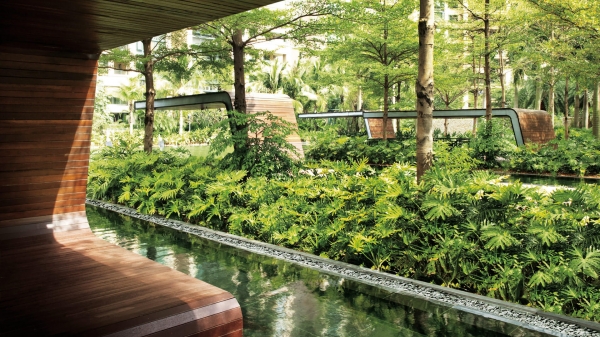
The classic example is Paley Park, a small pocket park in Midtown Manhattan designed by Zion & Breen and opened in 1967. A 20-foot waterfall at the back, pumping about 1,800 gallons a minute, covers the noise of 53rd Street.
Research shows why that works and where it doesn't. In a 2013 study in the Journal of the Acoustical Society of America, Galbrun and Ali of Heriot-Watt University found that water only masks traffic well when it is roughly as loud as the traffic, no more than about 3 dB quieter. Traffic is rich in low frequencies, and most fountains and streams aren't, except high-flow waterfalls. Listeners also tended to prefer the sound of streams over fountains, and fountains over waterfalls.
The practical lessons:
- Size the water to the job. A trickling bowl won't hide a highway. It works in a quiet courtyard.
- Put the water next to the seating, not by the road, so it's loud where people listen.
- Prefer moving, varied water, like a rill or a shallow stream over stones, to a single jet, and listen before committing.
Wind, Leaves and Garden Instruments
Plants are acoustic materials. Ornamental grasses hiss in light wind, bamboo knocks and creaks, and aspen and poplar leaves, which hang on flattened stalks, flutter and patter at the slightest breeze. Planting near a path or a bench turns wind into something you actually hear.
Japanese gardens took this further than anyone. A suikinkutsu is an upturned jar buried beneath a stone basin: water drips through a hole into a pool inside the jar, producing faint, bell-like notes. It became popular in the middle of the Edo period and was named for its resemblance to the sound of the koto. It was nearly forgotten by the mid-20th century; a 1959 survey reportedly found only two in Japan, both out of use. The shishi-odoshi, a pivoting bamboo tube that fills with water and clacks against a stone, punctuates a garden's quiet in much the same way.
Inviting Birdsong
You can't install birdsong, but you can make room for it. Layered planting, native species that carry insects and berries, and a shallow source of water bring birds in, and with them the most stress-relieving sound in the Buxton review. A garden that's quieter overall also lets birdsong carry further.
Listening as a Design Tool
The cover image above shows RUUP, three wooden megaphones about three meters across, built by students of the Estonian Academy of Arts and installed in a forest clearing near Estonia's Pähni Nature Centre in 2015. They add no sound at all. They amplify the forest, and people sit inside them to listen.
It's a good model for any outdoor project: before designing, walk the site at different times of day and listen. Note the keynote sounds, the intrusions and the places where something worth hearing already happens. Then design to protect and frame those sounds, and only add new ones where they're needed.
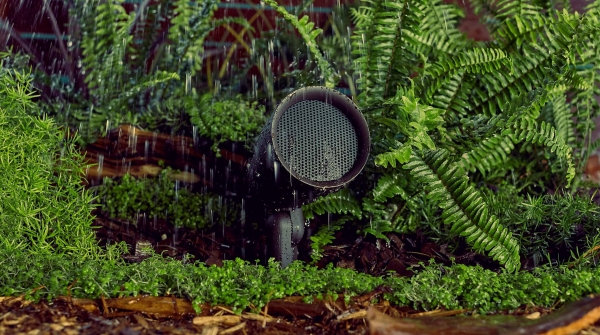
That's also where garden speakers belong: as a last layer, not the first. A recording of a river or rain played quietly on a city balcony can soften the city around you when there's no space for real water. Keep it low, and remember your neighbors can hear it too.
Indoors the same ideas apply to walls, ceilings and floors; we cover that in how sound shapes the way buildings feel. And if your only outdoor space is a balcony over a busy street, Noizio mixes more than 40 natural sounds on Mac and iOS, and the free web mixer lets you test a water or birdsong layer first.