
Walk into a stone cathedral and you lower your voice without being asked. Walk into a restaurant with bare concrete walls and you find yourself shouting across the table. Nobody pointed out the acoustics either time, but they decided how the room felt.
Barry Blesser and Linda-Ruth Salter call this aural architecture in their 2007 book Spaces Speak, Are You Listening? (MIT Press): the way a space's acoustics shape behavior and emotion, not just how well you can hear in it. Here's how that works, from the physics to the open-plan office.
Reverberation: The Main Dial
Clap in an empty room and listen to how long the sound hangs in the air. That decay is reverberation, and it's the single biggest factor in how a room sounds.
The science of it began with a complaint. In 1895, Harvard asked a young physicist, Wallace Clement Sabine, to fix the lecture hall in its new Fogg Art Museum, where students couldn't follow the speaker. Sabine measured a reverberation time of around five seconds: each word was still ringing when the next one arrived. He brought it down with sound-absorbing felt and worked out the relationship between a room's volume, its surfaces and how long sound lingers. He went on to advise on Boston's Symphony Hall, which opened in 1900 and is often described as the first concert hall designed with quantitative acoustics.
The right amount of reverberation depends on what the room is for:
- Classrooms need very little. The American standard ANSI/ASA S12.60 sets a limit of 0.6 seconds for a typical classroom, along with background noise of no more than 35 dBA, because children have to understand every word.
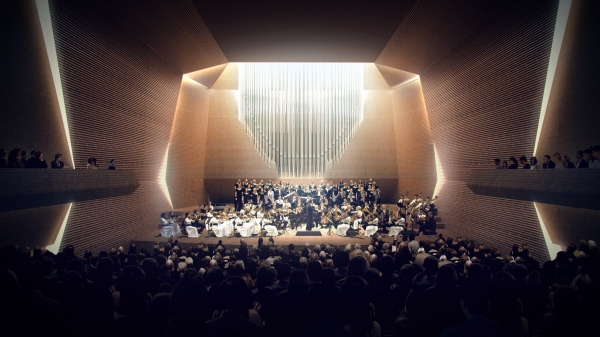
- Concert halls need much more. The acoustician Leo Beranek, who studied halls around the world, put the ideal for today's symphonic repertoire at about 1.9 seconds, enough for the orchestra to bloom without blurring.
- Great stone churches go to extremes. Stanford University's Icons of Sound project measured Hagia Sophia in Istanbul at more than ten seconds. Byzantine chant slows down to match the building.
Too much reverberation and speech turns to mush. Too little and a room feels flat, dead or oddly exposed.
Materials Decide What You Hear
Every surface does one of three things to sound. Hard, smooth materials like glass, concrete, stone and tile reflect it. Soft, porous ones like fabric, carpet, curtains and acoustic panels absorb it. Irregular surfaces diffuse it, scattering reflections in many directions so no single echo stands out.
The Elbphilharmonie in Hamburg, which opened in January 2017, is a famous case of diffusion. Its main hall is lined with about 10,000 individually milled gypsum-fiber panels, the "White Skin" developed by acoustician Yasuhisa Toyota with the architects. Each panel is covered in small carved cells shaped to spread sound evenly to every seat.
The same principles work at home. A bare room with a hard floor and big windows sounds harsh and makes conversations tiring. A rug, curtains, a full bookshelf and upholstered furniture will often change how the room feels more than a new coat of paint.
Why Open-Plan Offices Wear People Out
The trouble with open-plan offices isn't loudness so much as intelligible speech. A conversation you can follow is very hard to tune out, because the brain processes words whether you want it to or not.
Open plans were sold as a way to boost collaboration, and the evidence doesn't back that up. In 2018, Ethan Bernstein and Stephen Turban of Harvard tracked employees at two Fortune 500 headquarters before and after they moved to open-plan floors. Face-to-face interaction fell by roughly 70%, and email and messaging went up. Faced with constant exposure, people withdrew.
Lab work explains part of the cost. In a 2011 study by Haapakangas, Hongisto and colleagues in Finland, 54 participants did memory tasks with nearby speech playing. Speech hurt performance. Masking it helped, and the best masker was the sound of running spring water. Vocal music was about as distracting as the speech itself.
Sound Masking: Adding Sound to Get Quiet
That's the idea behind sound masking, now standard in many offices: a quiet, steady, engineered background sound from ceiling speakers, usually something like soft airflow. It doesn't make the room quieter. It makes nearby speech less intelligible, so it stops pulling at your attention.
You can do the same thing at a desk. A low layer of pink noise, white noise, steady rain or the indistinct murmur of a coffee shop covers your colleagues' words without adding new ones. We compare options in the best sounds for focus and study and look at the hype in brown noise and ADHD. The rule from the office research holds: steady and wordless beats music with lyrics.
Famous Acoustic Spaces
- The theater at Epidaurus. Visitors in the back rows of this ancient Greek theater can hear actors without amplification. A 2007 study by Nico Declercq and Cindy Dekeyser suggested one reason: the stepped rows of stone seats act as a filter that suppresses low-frequency background noise while letting the higher frequencies of voices through.
- Painted caves. Since the 1980s, the researcher Iegor Reznikoff has argued that Paleolithic paintings in caves such as Niaux cluster in spots with unusual resonance. It's an intriguing idea and still debated, but it suggests people have been choosing spaces by ear for a very long time.
- The quietest room on Earth. In 2015, an anechoic chamber in Building 87 on Microsoft's campus in Redmond, Washington, set a Guinness world record at −20.6 dBA, below the threshold of human hearing. It's built for testing devices, and it shows the opposite extreme: a room with no reflections at all.

Contemporary designers keep experimenting. In 2018, architect Thomas Wing-Evans and the State Library of New South Wales's DX Lab built 80Hz: Sound Lab, a small pavilion where visitors chose a painting from the collection and heard it translated into a generated soundscape played around them.
From Noise Control to Soundscape
For most of the 20th century, building acoustics was about reduction: fewer decibels, less echo. That's changing. The international standard ISO 12913-1, published in 2014, defines a soundscape as the "acoustic environment as perceived or experienced and/or understood by a person or people, in context." The emphasis on perception matters. Two rooms with the same decibel reading can feel completely different, depending on what you hear and whether it suits what you're doing.
Designing for sound means deciding what people should hear, not just what they shouldn't. Outdoors, that means water, wind and birdsong, which we cover in our guide to soundscape design for gardens. Indoors, it starts with softer surfaces, fewer hard echoes and a steady layer of sound where silence isn't possible.
If your own workspace is the problem, Noizio lets you build that layer on Mac and iOS, mixing more than 40 sounds from pink noise to rain, or you can try it free in the web mixer.